Pages

Showing posts with label Rise of Man. Show all posts

Wednesday, February 05, 2014

Bill Nye versus Ken Ham: Simplified Thinking All Around

Note: I know good people on all sides of the evolution debate.  Some base their opinions on logic and a scientific model and others on their faith.  Some using the the logic-scientific model accept a form of creationism while others who rely on a form of faith accept evolution.  Of course, the vice versa is also true.  This post is not meant to take sides on the debate but merely point out the flaws of the debate.
On Tuesday, Bill Nye "the Science Guy" debated Ken Ham, head of Answers in Genesis and the Creation Museum.  Nye dominated with logic and scientific examples while Ham relied primarily on the Bible instead of more scientific explanations.


It was not a representative debate for anyone.  First, "creationism" and "evolution" were not defined.  Old Earth Creationists, Progressive Creationists, and Theistic Evolutionists were ignored by Young Earth Ham.  Meanwhile, Nye never went into the internal divides of evolutionary theory.  For example, if you consider yourself a "Darwinist" you are outside the scientific mainstream.  Darwin's gradual evolution has been replaced by most scientists in favor of punctuated equilibrium.

The debate in the end was by two people deeply convicted in their own views which they presented as the only view.  Mr. Ham dismissed every sort of God-related theory but his own and Mr. Nye completely ignored any theory of evolution that involved God and kept his argument vague enough to not disown Darwin.

For more points of view check out this Catholic and Old Earth Creationism rebuttals to the debate itself.  For more information on other forms of creationism or God driven evolution check out these sites for Old Earth Creationism, Progressive Creationism, and Theistic Evolution (God made life through evolution).

Wednesday, March 13, 2013

Possible Multiple Branches of Homo Sapiens Throw Into Question the Genetic Adam & Eve Theory

I really do not understand the complex nature of genetic studies into human evolution.  The science quickly surpasses my attempts at understanding what is said.  However, TDAXP linked to an interesting Gene Expression post on how it appears that the whole theory of a genetic/mitochondrial Eve theory is flawed.

More and more it is looking like, as the blog post states, there "may have been... several admixture events with 'other' lineages, both within, and outside of, Africa."  Translation:  there may have been several groups of humans that mixed into the "out of Africa" humans we focus on when discussing the rise of man.  The rest is above my head but the implication is clear, our understanding of human evolution is still our best guess which is likely to change some more, much like our understanding of evolution itself has and expansion of humans into the Western Hemisphere.

TDAXP mentioned the "Land of Nod" when bringing the story to my attention.  I find that the Bibical reference is relevant to this possible scientific discovery, much further in fact than the simple Adam & Eve and mitochondrial Eve connection.

First, a bit of background.  In the Bible, Cain is forced to leave his home after he killed his brother Abel.  "Then Cain went away from the presence of the LORD, and dwelt in the land of Nod, east of Eden" (Genesis 4:16 RSV-CE).  However, before Cain does so he expressed his fear to God that others would kill him. "Then Cain said to the Lord, Guilt like mine is too great to find forgiveness. And now thou art robbing me of the ground, and I shall be cut off from thy protection, and wander over the earth, a fugitive; anyone I meet will slay me" (Genesis 4:13-14 Knox).  But it all worked out for Cain in the end because God gave him a mark of protection, got married, and started a family.

The question of who was Cain afraid of and where his wife came from has been a theological question for some for a long period of time.  While orthodox interpretations of Abrahamic faiths contend that these others are other children of Adam and Eve, there have been scatterings of Biblical literalists who contend that some souless form of humans lived before Adam and lived in Nod.  The theory became a common racist theme to set apart the Protestant White, Northern European race from others in the 1700s.  Today the pre-Adamite theory continues to divide some creationists.

While I am not trying to get religious on this topic, the reason why I am telling this religious aside is point out that once the orthodoxy (not necessarily the literalness but the orthodox interpretation) of Genesis was questioned a multitude of creation theories, of which pre-Adamites was just one, were disputed over for hundreds of years.  I fully expect that, if the pure-mitochondrial Eve rise of man theory is shown to be unlikely then we will be bombarded by many very scientific sound and unsound theories on the rise of man for decades.  However, I would take everything with skepticism because the more we find out about the rise of man the more we understand the gaps in our theories.

Monday, November 07, 2011

Genographic Project Indicates Humans Left Africa via a Land Bridge to Arabia

The Human DNA geography project Genographic, which I used and blogged about the proto-Catholicgauzes before, has DNA evidence which seems to confirm a new thought in human migration out of Africa: that Humans left Africa via a land bridge between Arabia and Africa and not the Sinai. 

The Out of Africa migration to Arabia is estimated to have happened "only" 70,000 years ago.

The study indicates that the Saharan Desert, despite having periods of greening, was truly a natural boundary preventing sub-Saharan Africans from moving north.  The Genographic-backed history has North Africans being the descendants of ancient people who lived in Greater Arabia before moving back into Africa.

If true, this story makes one grateful for the periods of low sea levels which aided the populating of not only the Americas around ~15,000 years ago but also the escape from Africa.

This evidence also has a modern day impact.  Hopefully it will be another nail in the coffin of pseudohistoric theories such as Afrocentrism in terms of Ancient Egyptians being Black, a theory embraced by some academics and even religions.

Thursday, February 18, 2010

Very Early Humans, Possibly Proto-Humans, May Have Sailed the Mediterranean Sea

It has been accepted that the ancestors of present-day Australian Aborigines traveled on sea craft from Indonesia to Australia around 60,000 years ago. Their sea voyage is thought to have been a major advancement and achievement in human thinking, social cohesion, and bravery. The feat is amazing and probably lies beyond the reach of many present-day people.

However, it may have not been the first. According to the New York Times a recent archaeological find could show very early Europeans traveled the seas well before their Australian Aborigine brethren. Tools found on the island of Crete seem to be at least 130,000 years old and maybe up to 700,000 years old. The tools are probably closer to 130,000 years old than the latter but this still pushes seafaring back 70,000 years!

The fascinating thing about this large time period is that it was one where Europe was populated by more than one type of human. Our Homo Sapien forefathers lived alongside and competed against Homo Heidelbergensis and Neanderthals. The fact that the tools look like non-Homo Sapien gives some credence to a proto-human origin (though just because tools like like another tool culture does not automatically mean they are related).

I can only imagine the drive and reason behind the early European seafarers. In the time before trade there would be no material need for sea travel. With very small populations nomadic peoples should have no understandable reason of sailing the Mediterranean. Some spirit of adventure, maybe, inspired a person or small clan to build a raft and travel where the currents and winds took them.

Thursday, December 03, 2009

Really Old Europe: Eastern Europe Home to One of the First Civilizations


Map of the Ancient Eastern European Cultures: Click to Enlarge

Almost 2,000 years before the start of Ancient Egypt and around the time ancient Mesopotamia was becoming the cradle of civilization, present-day Bulgaria, Romania, and Moldova were hosting the first European civilizations.

The New York Times has an interesting article about the subject of the new New York University exhibit on the Danube Valley civilizations of 5000 to 3500 BC. The Hamangia, Varna, and Cucuteni peoples created civilization complexes that included art and trade throughout much of the rest of Europe. The various cultures were based on settlers from present-day Greece who brought farming with them.

Like all ancient civilizations these ones either faded out or fell violently. Unfortunately, the prime suspect seems to be the proto-Catholicgauzes of the Steeps who brought with them mobile horses and fast attacks.

Wednesday, September 16, 2009

Skull Forces a Rethinking of the Human Exodus Out of Africa

The standard, accepted rise of man story consists of Homo erectus (proto-human aka hominin) being the first thing close to human to leave Africa around one million years ago. Homo sapien sapien (modern-man) later evolved into existence around 200,000 years ago and left Africa around 70,000 years ago.

However, scientists have discovered a hominin skull in Georgia, the country not the American state, that dates back to about 1.8 million years ago. The Georgian hominin is something that predates Homo Erectus. It is a smaller, dumber probable ancestor that likely used very basic tools similar to those of Homo habilis. At this stage of evolution habilis and the Georgian hominin look more ape-like than modern human.

The Georgian hominin may be evidence that Homo erectus evolved in Eurasia and not in Africa. However, if that is true something massive like climate change or alike forced humans out of Eurasia and back into Africa.

Regardless, the find is fascinating. Clearly we know only a small bit of our own history. Mapping the ebb and flow of migration and understanding the why behind it will answer old question but raise new ones as we try to understand just how man rose to the top of the world.

Wednesday, May 28, 2008

Dying Languages Link Siberia and New World Indians

One thing that has always raised eyebrows is the lack of cultural links between indigenous Siberians and New World Indians (excluding Eskimos who are not usually considered Indians because they came over much later). However, researchers have created a scientific test that links the American Na-Dene language to the Siberian Yeniseian language family. Na-Dene is centered in northwest Canada and eastern Alaska but was found in pockets in Texas.

The proposed common language goes back at least 10,000 years. This is interesting because the Bering Land Bridge was already gone 10,000 years ago. So either the common language and people are older than 10,000 years or there was still intercontinental contact after the land bridge was submerged. The latter is a realistic possibility because of short sea distances and global warming temperatures at the time.

Time is running out for some of these cultural studies. Greater integration is bettering the lives of many Indians but a side effect is the loss of these ancient ties. All those interested in American history and the rise of man should hurry in their race against time.

Tuesday, March 18, 2008

New Information Points to American Colonization in Steps

New information is leading scientists to believe the first main wave of migration to the Americas started 22,000 years ago but got stuck in Alaska. It took another 7,000 years for climate change to allow the colonization to continue south.

Another piece of evidence genetically links all Amero-Indians to six women who lived between 18,00 and 21,000 years ago.

The evidence further damages the Clovis First Theory of nothing before 12,000 years ago then massive population. What is missing from the studies is the step-colonization of 22,000 years ago the only wave before Europeans came. Many of the oldest Indian sights are along the Pacific coast in Central and South America. Interior artifacts of equal age are strangely missing.

Saturday, February 23, 2008

Geographic Genetic Chart


From Washington Post. Click to Enlarge

The Washington Post features an article with the above chart about genetic studies that "map" out humanity's diversity. The chart's information backs up the "Out of Africa" theory of human migration with a center point near present-day Addis Ababa, Ethiopia.

The chart shows the mixture of origins for ethnic groups based on a sample population's DNA. No real surprises but still neat to look at. Russians have some Central Asian pro-Catholicgauzes. Africans are "pure." The information shows the Middle East to be the ancient melting pot with various groups intermixing.

One neat thing to see in future research is to see if the "average" American has more ethnic genetic mixtures than the average Middle Easterner. I assume the United States has more ethnic groups than much of the Middle East but I cannot say how well intermixed America's population is.

Saturday, October 20, 2007

World's Oldest Painting Found

An 11,000 year old painting has been discovered in Syria. The ancient men who made the painting were still unable to farm or domesticate animals but something new was occurring in their brains. The geometric symbols, which unfortunately look like modern art and prove the Catholicgauze's opinions on modern art, meant something so important to the artist(s) that they spent considerable time, energy, and resources to make a prominent display.

Also around 11,000 years ago religion was picking up in Syria. While giant snake gods were known before hand elsewhere, it appears modern man's mind was evolving at a rapid pace during this time period.

Sunday, September 09, 2007

Indo-European Languages


Map of Indo-European languages. Orange are countries where an Indo-European language is dominant while yellow means an Indo-European is a minority language. (From Wikipedia)

Readers paying attention to the Kalash thread will notice Catholicgauze has encountered pro-Albanians who among other things claim 1) Alexander the Great was Albanian 2) Greeks and others are just Albanian posers 3) Albanians are the descendants of Atlantis and 4) Kalash are Albanians (I think, they have not been very clear). There evidence you ask? Some Albanian and Kalash words are similar! When Catholicgauze read that I slapped my head. That's because both Kalash and Albanian are Indo-European languages.

Under the leading theory, around the 4th millennium BC, the Kurgan people began to spread from out of the Pontic-Caspian steppe. The language of the Kurgan is thought to be the first Indo-European language. The vast dispersal was made possible because of the Kurgans use of horses. The Kurgan reach (and probable proto-Catholicgauzes) ranged from Western Europe to India. Today languages probably based from the Kurgan include English, German, French, Latin, Greek, Slavic, Farsi, Hindi, and many more.

As time progressed words changed but simpler ones continue to share similarities. Some words continue to remain almost universal between Indo-European languages. Just think of possibly the most common conversation in the world: "Mom? No!" "Mama? Non!" "Madre? No!" "Mutter? Nein!" "Mama? Nyet!" and so on and so on.

The Age of Colonization and then Imperialism allowed Indo-European languages (in particular English, Spanish, French, and Portuguese) to spread throughout the world. Today Indo-European Languages are either the official or an official secondary language in most countries. Seven of the top ten languages spoken by native speakers today are Indo-European.

The main contender to Indo-European is the Semitic language family of Arabic (spread via Islamic conquest), Hebrew (contained to the Jewish race) and a few other small religious languages such as Syriac (mostly in Eastern Christianity). Semitic languages are deeply interwinded with the religion of the respected speakers.

Niger-Congo is another competitor and it comprises most of sub-Saharan Africa. Many places which have a Niger-Congo language also recognize an Indo-European language due to the influence of colonization.

Other language families like Sino-Tibetan (Chinese, et al) and Japonic (Japanese and a few regional languages in Japan) are limited to one or a few national groups. While there was major European interaction with these groups, East Asia for the most part was able to adopt cultural advancements while still retaining their own identity.

Saturday, July 14, 2007

Rise of Man Across the Globe

Journey of Mankind is a time-lapsed map which shows the spread of mankind across the earth.
The map shows triumph and tragedy's our race has faced. The start in Africa, the failed colonization efforts by the "Cain" branch followed by "Seth" or "Adam." The Indian Ocean coast was the main path of migration until the Mt Toba eruption nearly killed off humanity. Southeast Asia then became the new starting point for the third wave of human migration.

The map also has additional information for each stage. Note how the cycles of global warming and cooling impacted the spread and decline of humans from locations.

The proto-Catholicgauzes sure were a traveling group. It is a wonder that they managed to survive and thrive while others perished.

(Hat tip: Infonaut)

Thursday, June 07, 2007

Polynesian Chickens Beat Columbus

Genetic scientists are patting themselves on the back because of their recent research that suggests Polynesians were in the Americas at least a century before Christopher Columbus (somewhere the Basques, Vikings, Indians, and other groups are shrugging off the news). The proof the study cites is DNA evidence of a few ancient chicken bones found in Chile.

To old-school (Berkley-school cultural geographers) this is no surprise. George Carter wrote an essay entitled "Pre-Columbian Chickens in America" which discussed the similarities between Asian and American cultures dealing with chickens. In a short summary, cultural geographer Charles Gritzner wrote back in 1977 in "Chicken, worms, and a little bull: some animated perspectives on American history":


"Of paramount importance is that Asian chickens lay with brown shells, as did those found among the American Indians at the time of European Contact. Mediterranean chickens (those which could have been transported by Spaniards or Portuguese navigators), on the other hand, lay white-shelled eggs. Both Asian and American Indians used chickens for sacrifice, divination, curing, and other rituals. To eat chickens was an acceptable practice in Europe, whereas poultry flesh was avoided by Asians and Indians alike."


Gritzner went on to support the claim that Jomon people reached America as early as 3,200 BC. He links the pottery of the Valdivia culture of Ecuador to the Jomon culture of Japan.

For more on pre-Columbian Chickens in America scroll down to "Gallus gallus" in Scientific Evidence for Pre-Columbian Transoceanic Voyages to and from the Americas or check out pages 16 and 17 from the sample of Poultry Breeding and Genetics.

Saturday, February 03, 2007

"Hobbits" of Indonesia their own Species?

18,000 years ago small, Hobbit like people lived in what is now Indonesia.

They would of had contact with Homo Sapiens (Nearby and hard to reach Australia had been inhabited since 42,000 years ago) but it appears they lived apart from one another.

A new study says these people were their own species which died out. While some dispute this it appears another branch has been added to man's family tree. These "Hobbits" are more cousin than parent, like the Neanderthals who died out 24,000 years ago.

Monday, January 22, 2007

Who were the First Americans?

As discussed yesterday, a Clovis-first theory just does not pan out.

Another theory that does not work is the "Ice-free" corridor theory in the Clovis timeline. This theory states that around 14,000 years ago Paleo-Indians blitzkrieged across barren lands of a freshly opened corridor and populated the Western Hemisphere in less than 500 years. It took Europeans hundreds if not thousands of years to claim lands abandoned by glaciers after the last ice age. The ice-corridor theory in a Clovis timeline suffers from other problems.
  • No archaeological evidence of Clovis or closely related pre-Clovis Indians can be found in Alaska or Siberia. In fact, the Eskimos of the region appear to come from a much more recent migration.
  • An ice-free corridor would be barren for a very long time, scarred by the glaciers and void of life. When it could support people and large game animals it would have also supported a type of extinct bear which could stand erect at 10 feet tall and thought people were delicious.
So where could the Paleo-Indians of come from and how did they reach America? The favored theory now is that they hugged the Pacific coast either walking and/or boating. Near the Monte Verde site there were Indians which lived as a boating culture surviving along the coast huntings seals and fish for protein up until the early twentieth century.

The exact point of origin is also difficult to determine. Genetics and teeth shape point towards the traditional spot of northeast Asia. There are oddities however:
  • Pottery found in Ecuador bears striking similarities to the Ainu (Caucasian Japanese) culture of Japan. Also, the Spanish encountered chickens which laid brown eggs (native Asian chickens do this, not native North American) and the natives used the entrails to forecast the future- another Ainu trait found no where else in the Americas. Before one pushes this fact aside know that Asian fishings were a fairly common site in the New World after the Spanish arrived. Surviving a journey was possible.
  • Another mystery is Haplogroup X. This group is a very scattered one comprising about 2% of Europeans and a fair amount of people in the Near East. It is also surprisingly found 25% of Algonquian speaking people. How this is possible is anyone's guess.

Catholicgauze has no grandiose theories of his own. He just wants people to know about our mysterious world.

Wednesday, September 20, 2006

Ice Age Britain was a site of many human failures

Humans first came to Great Britain around 700,000 years ago; however, the first sucessful settlement was only 12,000 years ago. The reason was because the ice sheets from the Ice Age would constantly push people out. The move-in and move-out occured seven different times!

Be sure to read the hyperlinks as National Geographic provides fascinating details.

Category: Historical Geography

Monday, April 10, 2006

Who were the Proto-catholicgauzes?

My investigation of the proto-catholicgauzes via the Genographic Project and other means continues.

After doing a long Google search I found that the Little Family DNA Project had some information which aided me. DNA maps of the British Isles, Europe, and the World gave me a good idea of R1a's journey and settlement.

It appears that R1a is big in the former Eastern Europe, Russia and Norway. The areas in the British Isles where R1a holds it own are Shetland, Orkney, and the Isle of Man. These areas were once ruled by Norway way back in the Viking days. However, none of these places are English. The London area has a marginal R1a population of four to one percent. So where did my R1a'ers come from? The odds are against Norway. Perhaps Huns? The search continues.


Category: Miscellaneous

Wednesday, March 22, 2006

Genographic Travels of the proto-Catholicgauzes

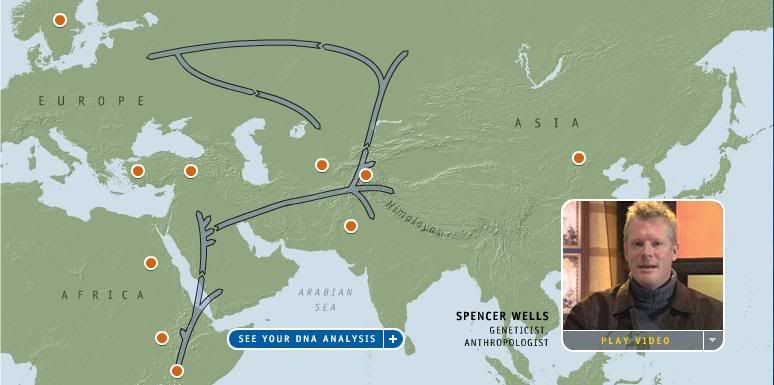
The Journey of R1a, Catholicgauze's group

National Geographic is currently running one of the most epic geographical projects in the history, no kidding. The Genographic Project seeks to map the journey of humankind from eastern Africa. Right now it is possible to trace one’s roots from the dawn of man up to approximately 10,000 B.C.

The fee is $107 to buy a kit but I believe it is well worth the money. Genographic will either trace the lineage of the Y-chromosome for men or the Mitochondrial DNA for women. All that is required is two samplings from one’s cheek and it can be done in the comforts of one home. Then one waits for about two months and checks online for the story of their distant ancestors.

Catholicgauze recently did his own test and found out about the journey of an “African Adam” (much more of a Cain than an Adam however) who ditched his clan, started a journey out of Africa, and became responsible for all of the non-Africans in the world.

Catholicgauze’s ancestors stayed in the Mideast for a while, went east into India (while many European ancestors went north into the Caucuses Mountains), lived in the steppes, traveled west into they hit glaciers, and then returned to the steppes. The Y-chromosome group, M17, is commonly found from the Czech Republic all the way to northern India. The ancestors of these people were the Kurgans. The Kurgans started the Indo-European language family and were the first to domesticate horses which were used for agriculture and migration.

This all came as quite of a surprise to me. My father’s male line is one of blue blooded Englishmen so I was expecting a more “European” line. I was thinking maybe a pure Roman lineage. Maybe my ancestors came to Europe soon afterwards or as part of the barbarian invasions against Rome, became Saxons, then Anglo-Saxons. These are some very scenarios for me to ponder.

Over the next few years National Geographic, especially the .COM department, plans to expand on the information available. The hope is to have information relating to human migration with Alexander, Rome, Roma, rise of Islam and Arabs, and etc. I am hoping they are able to pull it off. Having more modern information would give a greater understanding of the human journey to people.

This is a must buy if you can afford to pay the $107 and are a fan of tracing your roots. It is not a genealogical project; however, so do not plan on finding out where great-grandpa was from. Besides that, Genographic is perfect!

Be sure to check out the online atlas which has all the different type of DNA paths.

Category: Miscellaneous