The Geography Blog focusing on all things geography: human, physical, technical, space, news, and geopolitics. Also known as Geographic Travels with Catholicgauze!
Written by a former National Geographic employee who also proudly served in Iraq and Afghanistan.
Knowledge of the geography of the Holy Land is sometimes referred to as the fifth gospel. Wars, geopolitics, trade routes, migration, and human-environment interaction all played roles in the events of both the Old and New Testament. To fully understand the story one needs to understand the geography.
Dr. James McGrath of Butler University has uploaded a thirty minute lecture on Old Testament geography. This board overview does not going into overwhelming detail but instead focuses on the broad themes.
A long Catholicgauze rant. Normal geography blogging will resume tomorrow
I heard ghosts of whispers while I was in Afghanistan. I could not confirm these details but they were very troubling to me.
At an Indian restaurant (the restaurant was meant to attract Afghans who developed a taste for Indian food while in exile as refugees as well as Westerners who enjoined Indian food) several truck drivers were sitting near us were talking. The interpreter I worked with said they were talking about Arabs claiming to be al Qaeda who were running road blocks in the open along the main highway which connected all four major Afghan cities.
An Afghan newspaper published in Kabul for the business-class reported al Qaeda, not the Taliban nor the Islamic Movement of Uzbekistan, was reestablishing bases in Nuristan province. The article stated that al Qaeda viewed Nuristan safer than Pakistan because there were less drone strikes and the American presence was weak in the mountainous province.
Finally, many soldiers told me either first or second hand stories of seeing women in Arab dresses vice standard Afghan clothing walking around markets without men. If these stories were true, then it implies foreign fighters, possibly al Qaeda, felt Afghanistan was so safe that they were bringing their wives along. In Afghanistan, only women who knew they were untouchable and feared would dare walk out to a public place without a male relative.
I never knew what to make of such stories. However, they all added together to paint a picture of slow moving defeat. If al Qaeda were able to establish itself, then the war would be a waste.
Today the reaction to news about Afghanistan is shocking. Americans are being killed by infiltrators and traitors in the Afghan army and police. We passed the "grim milestone" of 2,000 military killed. Yet unlike Iraq, where the press was eager to point out the bad news and it became political capital, neither party is discussing Afghanistan. It is a war America wants to forget. President George W Bush's promise of "We will not tire, we will not falter, we will not fail" is being turned into a joke by the American people.
The press seems to go along with this. In Sunday's Washington Post described how the war was "winding down". Elsewhere the press portrays the message that with bin Laden death al Qaeda died as well.
Thankfully, journalist Lara Logan has pointed out that most of what Americans are being told is wrong (in my less than humble opinion). If she is right, and I fear she is, a new storm is coming which poses dangers even larger than a 9/11.
Here powerful point can be summed up by this portion of her speech
“Our way of life is under attack and if you think that’s
government propaganda, if you think that’s nonsense, if you think that’s
warmongering, you’re not listening to what the people who are fighting
you say about this fight.”
“In your arrogance, you think you write the script, but you don’t. There’s two sides and we don’t dictate the terms.
In fact after eleven years of war in Afghanistan, we’re rushing for the
exits as fast as we can, not only do we not dictate the terms, but we
have less power to dictate anything on the world stage.”
“Ambassador Ryan Crocker said, ‘We’ve killed all the slow and stupid
ones. The ones that are left are more committed and they didn’t become
any kinder or gentler in the last eleven years.’
“‘Another thing he said. We think we’ve won the campaign and they haven’t even begun to fight.’”
“If you fail to identify the ideological component to this fight, if
you fail to identify what your enemy is really fighting for, if you lie
about who they really are, I don’t see how you can possibly have the
right strategy.”
“There’s a narrative coming out of Washington, much of it driven by
Pakistani lobbying money and by Taliban apologists. One of my favorite
things to read about is how the Taliban today is so unlike the Taliban
of 2001, they’re a more moderate, gentler kinder Taliban who just can’t
wait to see women in the workplace occupying an equal role in society
and great economic prosperity for all of Afghanistan and they don’t
really want to take us back 3,000 years into that terrible place I
witnessed.”
“And when I look at what’s happening in Libya, this big song and
dance, whether this was a terrorist attack or a protest, and you just
want to scream for god’s sake, are you kidding me, the last time we were
attacked like this was the USS Cole which was a prelude to the 1998
embassy bombings which was a prelude to 9/11. And you’re sending FBI to
investigate. I hope you’re sending in your best clandestine warriors who
will go in to exact revenge and let the world know that the United
States will not be attacked on its own soil, that its ambassadors will
not be murdered and that the United States will not do nothing about
it.”
The Arab Civil Wars are likely to get even hotter and al Qaeda is viewed by many as a fighter against oppressive regimes. While the US will push for leaders to step down and bomb Libya, Arabs who are not militant Islamists see how al Qaeda has been on the ground in Libya, Syria, and Yemen. Americans want to disengage from the Greater Middle East and rebuild the economy at home. However, we have involved ourselves deeply and now the storm will not let us go.
Google Earth Blog pointed out that Google Earth has a neat weather layer built-in for easy viewing. "Simply by turning on the [Clouds] and [Radar] layers inside of the main
[Weather] layer, you can get a great look at clouds and precipitation
around the world." Be sure to check out Google Earth Blog's Weather Toolbox for more in-depth tools to try out.
From Google Earth Blog
Meteorology is a weak point of mine so it will be interesting to see if I can successfully use these tools to gain a better understanding of weather systems.
On October 14, 1962 an American U2 spy plane flew over the island of Cuba and took photos of Soviet military-built missile facilities. The United States saw the facilities as part of a Soviet first strike operation. The Soviets meanwhile saw no difference between their desires for nuclear weapons in Cuba and American nuclear weapons already in Turkey, which border the Soviet Union. The tension quickly built up between the United States and the Union of
Soviet Socialist Republics to the point each side nearly started World
War III.
Thankfully war was averted though few Americans fully understood what occurred. American President John Kennedy sought to explain the situation and dispel beliefs that the Soviets had kept weapons hidden on the island. To do so the Defense Intelligence Agency's John Hughes went on television on February 6, 1963 and used geographic tools such as maps and photo interpretation to explain the Soviet buildup, threat, and withdrawal.
Below are eight clips from the briefing.
Today the use of photo interpretation and maps to investigate non-geography oriented subjects is common place. For example public agencies in charge of wildlife management, fire control, military planning use these techniques. Even private groups like those interested in real estate development or legal issues with property ownership will study maps and recent imagery to obtain on the ground facts photos give as well as other, less visible factors maps describe.
As a follow-up to the geography of penis sizes, a geographer wondered if the geography of women's breast sizes would co-relate to that of the male reproductive organ. The answer seems to be: mostly not. The German website Blid.de (English language link) made a map claiming to show women's breast sizes on a cup scale by country.
From Blid.de
The one strong co-relation between the two is that East Asia has the smallest of both. Africa, while leading in the men's category, is universally in the small category for women. Russians, Finns, and Viking Germanics lead overall with other Germanics coming in second throughout the world. Most Slavs, however, though do not have as nearly as large of breast as those of their Russian kin. Interestingly, countries which once were part of the original Muslim expansion ranging from Portugal to India are almost all B-cup. It would be eat to see if this is a genetic import from Peninsula Arabs or something else.
All this depends on the accuracy of the data and my theories ignore the extent of plastic surgery.
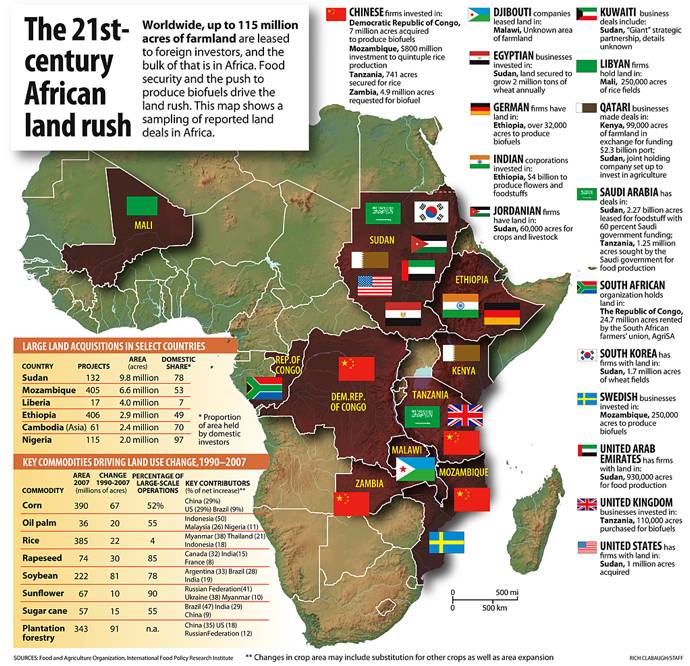
In Kenya one can see an endless rows of tea plants growing. The tea belongs to Lipton Tea Company, through its Kenya division. Locals do not drink Lipton, they strongly dislike the taste, but Lipton Tea realizes how much money it can save by growing its crop on rented African farmlands and then exporting it to customer countries.
Lipton is not alone. Many private, government owned, and public-private partnerships from developed and developing world realize the economic feasibility of renting African farmland. Seth Dixon's Geography Education featured a pre-2011 map showing various countries' (representing both state and private enterprises) land holdings in Africa.
Click to Enlarge
According to the map the Saudi Arabia is the behemoth in terms of African farmlands. Saudi Arabia, mostly desert and unable to feed its population by itself, seeks to end its dependency of buying food by renting 2.27 billion (with a "b") acres (~918.6 million hectares) of farmland in Sudan for food production. It would be interesting to see if this farmland is located in present-day South Sudan. If so it would explain the friendly relations Saudi Arabia quickly made with South Sudan.
The People's Republic of China comes in second for landholdings with over 11.9 million acres (~4.8 million hectares) of farmland in the Democratic Republic of Congo and Zambia. These lands grow crops for biofuel production. China sees Africa as the place to produce a renewable Arabia of biofuels to feed its growing economy. China's many investments in making friends in Africa will be rewarded with renewable biofuels.
South Africa, South Korea, and then the United States round up the foreign owners with each one holding over a million acres acquired.
Interestingly, African countries are getting into the land renting business. South Africa's farmers' union AgriSA rents 24.7 million acres (~10 million hectares) in the Republic of Congo while Djibouti is renting in Malawi. Meanwhile Egypt rents land in Sudan as did Libya in Mali (no idea if they still do). None of the African countries, sans Egypt in Sudan which have long ties together, rent from neighbors. Perhaps the intense geopolitics of neighbors due to European-designed artificial borders in Africa makes this impossible. However, Arab-influenced Djibouti has no quarrels with states in southern Africa and majority-ruled South Africa and the Republic of Congo have never had animosity against each other. In Africa, distance makes good farmland business partners.
GIM International has an interesting article about how radar on satellites are being used to map landslides in Switzerland. Knowing the exact extent of landslides overlayed on top of geographic data allows for planning of evacuation routes and improvement of infrastructure. The article is short but it gives the reader how geography and technology pair up nicely together to solve critical, real world problems.