A short film in the style of Mr. Bean (Hat Tip: The Map Room)
Tuesday, September 22, 2009


Monday, September 21, 2009
Dubai's World Islands Project Killed
View Larger Map
Not quite the final design as imagined
Dubai's World Islands project (official website) has been apparently killed off due to the economic downturn. It appears that there are too few buyers and it is too costly to maintain. Huge towers, palm islands, and more has made Dubai a modern day Babylon in some people's minds due to its material boasting. It appears the economic downturn and oil prices no longer at their highest of highs has made New Babylon run out of money. (Hat tip: The Map Room and Gadling)
All this can only mean one thing: it is Catholicgauze's time to shine. I have contacted the The World Islands project and sent an inquire to the United Arab Emirates' embassy to see if it is possible to buy a jar of sand or something on the cheap. Like any fallen civilization, the looters are already here.
Sunday, September 20, 2009
10 Geological Wonders You Didn't Know
Going around the internet is 10 Geological Wonders You Didn't Know. The website feature list ten geomorphic wonders with a picture of each and a short description along with a link. Featured sites include sand dunes turned into rock, a "gate to Hell" in Uzbekistan, and much more.
Saturday, September 19, 2009
New Map Blog Find: ¡Maps, mapas!
Catholicgauze has found a map blog of interest: ¡Maps, mapas! Mapas is a Mexico-based, Spanish language blog features historical maps series, modern digital atlases, and mapping news events. Even if one does not know Spanish, maps tend to be universal.
Friday, September 18, 2009
First Rock Planet Discovered Outside Our Solar System
Extrasolar planets (planets outside our solar system) have been known for a while now. In the past Catholicgauze has linked to an online, Star Trek-themed encyclopedia of extrasolar planets. However, in the past all known extrasolar planets were thought to be gas giants and not rocky planets like Earth. This has changed. Corot 7b has been discovered and is thought to be rock-based. The planet is five hundred light years away with a surface temperature of 2,700 degrees Fahrenheit (1,500 degrees Celsius)!
The linked article discusses the possibility of life being found on some rocky planet. The conversation is meaningless as far as I am concerned for several reasons. 1) It was no surprise that rocky planets are out there 2) Even if there wasn't rocky planets out there gas planets would be capable of having its own form of truly alien life 3) there are no religious qualms with life on other planets.
In the ancient Christian past, great minds like Saint Augustine of Hippo stated there could be no land outside of the European/Asian/African core. His geographical theology was shattered by the discovery of the new world. If there could be another hemisphere outside of the Jewish/Christian reach, why not whole worlds?
Thursday, September 17, 2009
Maps of places mentioned in books
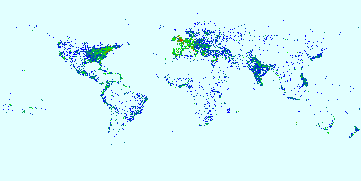
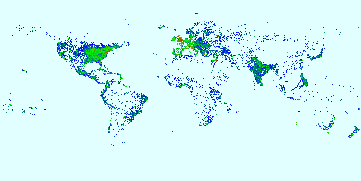
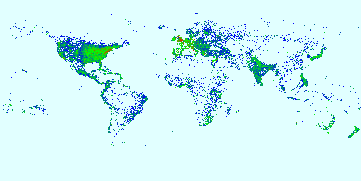
TDAXP twittered a link that shows the advancement of place mentions in, primarily Western, literature. Inside Google Books has made a code that maps locations in books and magazines that are featured in Google Books. The maps (below) show the advancement of geographic mentioning and therefore knowledge of places around the world. Be sure to note the correlation of imperial expansion and place mentioning.
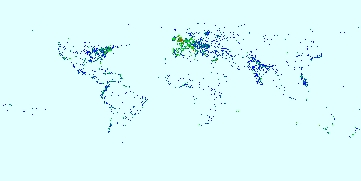
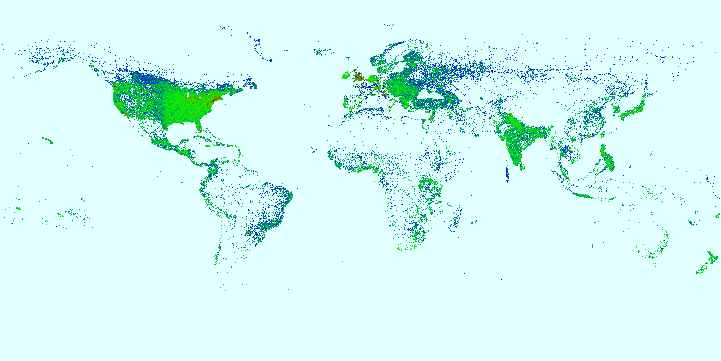
1800
1830
1860
1890
Today
Wednesday, September 16, 2009
Skull Forces a Rethinking of the Human Exodus Out of Africa
The standard, accepted rise of man story consists of Homo erectus (proto-human aka hominin) being the first thing close to human to leave Africa around one million years ago. Homo sapien sapien (modern-man) later evolved into existence around 200,000 years ago and left Africa around 70,000 years ago.
However, scientists have discovered a hominin skull in Georgia, the country not the American state, that dates back to about 1.8 million years ago. The Georgian hominin is something that predates Homo Erectus. It is a smaller, dumber probable ancestor that likely used very basic tools similar to those of Homo habilis. At this stage of evolution habilis and the Georgian hominin look more ape-like than modern human.
The Georgian hominin may be evidence that Homo erectus evolved in Eurasia and not in Africa. However, if that is true something massive like climate change or alike forced humans out of Eurasia and back into Africa.
Regardless, the find is fascinating. Clearly we know only a small bit of our own history. Mapping the ebb and flow of migration and understanding the why behind it will answer old question but raise new ones as we try to understand just how man rose to the top of the world.
Subscribe to:
Posts (Atom)