The Geography Blog focusing on all things geography: human, physical, technical, space, news, and geopolitics. Also known as Geographic Travels with Catholicgauze! Written by a former National Geographic employee who also proudly served in Iraq and Afghanistan.
Friday, May 23, 2014
Jerzy Popieluszko: Religion and Geography
Friday, November 16, 2012
Geography of James Bond
View The Geography of Bond in a larger map
London has been in every Bond movie except You Only Live Twice and Moonraker. The other top most visited cities by James Bond are
- Istanbul (Near East Oriental exoticism)
- Hong Kong (Far East Oriental exoticism)
- Venice (Picturesque Europe)
Thursday, July 21, 2011
The World Geography's Top Ten Geography Errors in Movies
The website The World Geography has created their own list of geography movie mistakes. The best one's pointed out where Krakatoa, East of Java (Krakatoa is actually west of Java) and the multiple "Mexico=Peru" errors in Indiana Jones and the Kingdom of the Crystal Skull.
Friday, October 29, 2010
Cultural Geography Notes for Halloween Movies
Dracula (1931-Spanish edition)
During the same time that the famous version with Bela Lugosi was being filmed Universal was also creating a Spanish-edition. The actors for this film came from all over the Hispanic world ranging from Mexico, to Spain, to Argentina. In an effort to show Spanish language films were good as English language efforts the actors and staff worked hard to "one up" the English-language film crew. They were successful in creating a better technical film that was longer and more faithful to the book than Lugosi's movie.
An unrelated thing to take note is that the Hispanic film was unencumbered by English cultural morals of not revealing too much with the women's nightgowns.
Tim Estiloz has more on the Spanish-language version of Dracula
Let the Right One In
Let the Right One In is the Swedish vampire hit that was recently redone with the American movie Let Me In. The movie is truly a product of modern Western Europe: willing to accept other worlds except those that deal with Christianity. While permission and sunlight make prominent parts of the film there is not one mention of a church, cross, or holy water to deal with the most manipulative vampire in a movie ever.
Bubba Ho-Tep
Bubba Ho-Tep is a proper homage to B-monster movies by the primary B-actor: Bruce Cambell. The films staring an aged "Elvis" and "John Kennedy" as they battle an Egyptian mummy which feasts upon residents of a nursing home. A forgotten part of east Texas, which is an overlooked part of the country to many, provides the background to a film about how American cultural does not value its old. But it is mostly a dark comedy about Elvis and JFK versus a mummy.
Do you have your own favorite Halloween movie and any cultural geographic insight to share about it? If so please comment!
Friday, October 15, 2010
God In America
The show does a good job showing how English Puritan Protestantism greatly impacted America. The Puritans focused on the Old Testament, unique among Christians at the time, and saw themselves as the remnant of the true faith leaving Egypt (England) for the promised land (America). Seeing America as a blank slate and a "city upon the hill" infused the United States with the belief that religion is critical for the country and America is God's country.
That belief has greatly impacted the country: Dissenter religions like Methodism which could claim direct contact with God flourished, Americanist religions like Mormonism were born, Manifest Destiny gave the country a conquering spirit over the American Indian nations, and politics and religion have been closely intertwined in issues ranging from education to civil rights to geopolitics.
God In America is long but it is an intimate, person-driven account of how religion has impacted the United States.
Tuesday, August 31, 2010
Restrepo: When Counter-Insurgency Meets Rough Geography
A section of The Accidental Guerrilla is dedicated to the construction of a road through Kunar Province. The Coalition was successful in persuading local Afghans to buy in to the road and get involved with its construction. The invested Afghans then ensured their road was protected by creating a societal gap between themselves and the Taliban who wished to harm both the road and Coalition forces who used the road. Despite rough terrain and a typically isolated Pashtun population, successful counter-insurgency tactics allowed for a Coalition victory.
However, not far away in Kunar Province is the Korangal Valley. This valley is full of steep ridges and deep valleys. It is located near the Pakistan border. It is also in this valley where United States soldiers step up several firebases and began a road construction project in the mold of the other Kunar project. Unlike the other project, though, the geography in valley did not favor a similar outcome. The valley and the soldiers are at the center of the documentary Restrepo which documents one of the most hotly contested parts of Afghanistan.
The first issue was the physical geography. The first base was in a bowl which the Taliban could easily shoot into. After a few firefights the Americans take the initiative and seize the commanding heights. However, there are too few troops to push the advantage and keep forcing the Taliban to fall back. After a while there is an offensive operation but the ground cannot be held because the lack of troops and the close-range fighting which resulted in both American and civilian causalities. Much of the remainder of the time is spent fighting between a static line of control.
The second major problem was the human terrain. Tribal and elder leadership did not value the road like elsewhere in Kunar and villagers would not build the road without elder approval. Instead the elders wished to discuss damage done by soldiers and detained locals. The American commander's various responses and blame shifting prevented any bonds from growing.
What was the result? A Taliban victory. A postscript describes how the military abandoned the valley in April 2010. The Taliban quickly released videos of their exploration of the Coalition firebases.
The rough physical terrain dwarfed the limited amount of troops who were stationed in the valley. The local population could have been a massive force multiplier and could have made the Taliban easy targets. However, the failure to culturally engaged and the style of warfare made the locals neutral at best and hostile in many cases.
Restrepo is a good documentary on multiple levels. It shows what has gone wrong in Afghanistan but it also portrays the bravery of soldiers who risk their lives for the Afghans and every other free citizen of the world.
Monday, January 18, 2010
Afghan Star

Friday, June 12, 2009
Where Europe Ends
The documentary "Where Europe Ends" is an hour long survey of regions that are European but outside the Union. The documentary looks at lands like Moldova and Transnitria, the ethnically mixed Transcarpathian region in Western Ukraine, and Black Sea Coast. Those already knowledgeable in these regions will not learn anything new but will appreciate the personal stories of Romanians, Jews, Germans, and others who have fallen through the cracks Russia and the European Union.
When the documentary talks about the history of regions one quickly realizes those lands beyond Europe(an Union) have long been moving towards and away the greater European cultural realm. Ancient Greece colonized the northern Black Sea coast. The Republic of Genoa extended Italian influence there as well. Germans brought Central European culture with them into southeastern Europe (ethnic Germans were fierce opponents of their price, Vlad "Dracula" Tepes, in part because of leadership not paying bills and Vlad's habit of impelling his ethnic German subjects), the Baltic (Teutonic Knights battled Orthodox and Pagans to gain massive cultural sway there until the end of World War II), and even past the Volga River (Volga Germans had their own autonomous Soviet republic). However, these attempts to bring/impose Europe were ended either by barbarian, Turkish, and Communist conquests. Each of these invaders sought to rebuild these lands in their own image. What they left beyond was instead fragmented cultures.
Today many in the outside zones of Europe want to be members of the European Union. They see how European Union membership has not only aided the core countries but has seemingly improved many former Soviet satellite states as well. Opposing them are homeland corruption, a ruler in Moscow wants a buffered Eurasian empire, and European Union elites who see the outsiders as pests not worthy to share in the common market. Hopefully the European Union can spread bringing open-government liberalism and economic improvement to the European overlooked lands while importing positive Eastern European traits. Time will tell though if Europe can finally hold onto these outside lands or if a new horde will keep them geographically separate yet again.
Wednesday, April 29, 2009
Olympus Inferno
Olympus Inferno is the latest and hottest movie in Russia. Almost twenty-five percent of all Russians tuned in to watch it, according to Russian Channel One. It is also a prime example of Russian propaganda. Even so, Olympus Inferno is required watching for anyone wishing to see the Russian point-of-view of the 2008 Russia-Georgia War.
***SPOILERS***
The movie features two main characters: an American male of Russian descent and a Russian female. The two are studying a rare butterfly when they accidentally witness and film the Georgian military invading South Ossetia. After being left to die by American peacekeepers and chased by a Georgian supercommando, both finally make it to safety by being rescued by the advancing Russian military. At the end of the film, the American decides not to return to "materialistic and empty" America but instead begin a new life with the Russian woman who he falls in love with.
The film definitely hat tips recent western films. I noticed action sequences and pans that borrow heavily from films like Behind Enemy Lines and the Bourne movies. Moscow accepts Western film schools now, unlike in the Cold War.
That's where the Western perspective of the movie ends. The film is clearly pro-Russian and anti-everything else.
- The film has Russian president Dmitriy Medvedev as the voice of reason. Putin is no where to be seen.
- The film starts with Georgian president Mikhail Saakashvili promising peace. When the American character sees he believes Saakashvili the female makes fun of the American's ignorance and warns that Saakashvili is not to be believed.
- Georgian military equipment purposefully attacks civilian targets while waving massive Georgian flags.
- US peacekeepers refuse to help the heroes and American media tell the Georgians where the two are hiding. Never mind there were no American military personnel in Georgia except embassy guards.
- Even Ossetians come across in a not so positive light. They are shown as badly clothed, bumpkins without a government, who fight with old weaponry, and will turn on each other with minimal prompting. An Ossetian blogger denounced the colonial attitude which the film depicts South Ossetians. The film probably shows Ossetians this way in order to imply that they were completely helpless and needed the Russians to save them.
The Russian film industry has benefited from Russia's resurgence and government funding. Watching Russian films like Olympus Inferno offer a window into their world. Right now it is a world full of incompetent yet shady Americans, evil American allies, loyal Russians trapped in the Near Aboard, and heroic Russians. With films coming out later this year dealing with Ukraine it will be interesting to see how the Russian worldview sees its western border.
Sunday, March 11, 2007
Geography and Film: 300

300 is based on a graphic novel which in turn is based on the Battle of Thermopylae. I would rate the movie about 4.5 out of 5 praising it for its battle scenes and artistic style but wondering if all the nudity in the first part was necessary.
For those interested in the actual battle and how it compares to the movie Victor David Hanson has the knowledgeable information.
SPOILERS AHEAD
The geography of the film is fantastic in that it is both great and preternatural. Greece is depicted as a land of muscular men, strong and beautiful women, and picturesque lands. The Persian Empire on the other hand is a cosmopolitan mixture of everything that is morally wrong. War elephants and war rhinos are fierce beats, the Persian Immortals and other elite troops of Xerxes are physically corrupted humans. Not since the days of religious plays have the inner strengths and weaknesses been shown as physical qualities in such a dramatic way.
Another aspect in the film is politics. While the film makers deny political bias it is clear the beliefs of Frank Miller have played a role. Queen Gorgo makes the case for the war while the oracle priests (the United Nations) are swayed by bribes and Spartan politicans feel this is not their war (anti-Iraq War Democrats). "Freedom is not free," says the queen to the council. Elsewhere in the movie the Spartan king turns down offers of an "exchange of cultures" and personal honors which would be exchanged for surrender of rights and freedoms. At the end of the movie a soldier named Dilios tells the united Greek at army that this is war against "mysticism and tyranny." Sound familiar?
SPOILERS END
In case you need any more reason to see the film check out the trailer below. PREPARE FOR GLORY!
Tuesday, January 30, 2007
Jet Li's Fearless

Jet Li's Fearless is an excellent martial arts film with enough drama elements to appeal to both sexes. From a geographer's point-of-view it reveals a Chinese perspective on Westernization, honor, and the urban/rural relationship.
SPOILERS AHEAD
The film is loosely based on the life of Chinese martial arts expert Huo Yuanjia. In the initial third of the movie Yuanjia lives the high-life fighting to become the city's champion. He enriches himself, has a family, and spends lavishly on his friends. He is the nineteenth-century's playboy. He fights for the sheer pleasure of it and fails to recognize honor. When a gaffe of a biblical-proportion occurs because of his lack of honor he goes in self-imposed exile.
Redemption is learned in the rural country side. Here is a clean environment where family is valued. Things like rice are valued above riches. In short the country side becomes a healing place and the antithesis of the city.
When Yuanjia returns to the city to right his past it is a very different place. Soldiers from British India, camels, and missionaries are in the streets. Westernization is occurring.
The movie handles this issue patriotically but not xenophobicly. Yuanjia's friend shows how Westernization and capitalism can help China using China's historic fall from empire to Sick Man of Asia. The heads of the foreign powers are shown as shadowy snakes. The Japanese leader comes off the most negative being the brains of the anti-Chinese group.
The way the foreign fighters are depicted is the most interesting part. The American is a huge, war brute with no quick moves but with mighty power. However, after realizing the skills and honor of Yuanjia the American cheers Yuanjia's victory. The European fighters are only shown on screen fighting and have no redeeming qualities. The Japanese fighter completely counters the negativity of his leader. The fighter meets Yuanjia before the fight and realizes he is an honorable worthy of victory.
Fearless is an excellent movie with a great soundtrack. Rent it today!
Thursday, October 26, 2006
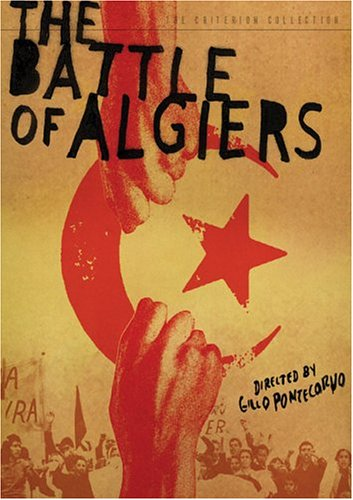
Geography and Film: Battle of Algiers

The Battle of Algiers is hands down of the best war films ever. The movie is loosely based on the book by Saadi Yacef and concerns the urban guerrilla battle for the city of Algiers during the Algerian Independence War. The movie first shows how Algerian FLN tried to create an ungoverned space, fill the vacuum, and then extend their control. The FLN first attacked French police on patrol and enforced their own laws. The police retaliated by bombing FLN areas with small explosive devices. A tick-for-tat style of warfare started reaching a climax with the introduction of French paratroopers.
Unlike the book, written by a Algerian FLN commander, the movie is unbiased. I have discussed the film with several people and we all agreed that one sees what they want to see. When the French military resorts to extreme measures to defeat the FLN a leftist may see horrible, amoral torture while a rightist may see a necessary evil to save lives.
The movie shows many geographical elements. Algiers was a collection of French and Arab neighborhoods which were worlds apart. While the French liked their neighborhoods French many of the lower jobs were done by Algerians (much like the American-Mexican relationship. The world was also showing signs of globalization in the 1950s with Coca-Cola is enjoyed by the Pied-noir French. Finally, the fourth generation warfare tactic of media battles is shown with the FLN trying to get sympathetic media and therefore the world community on their side.
While the FLN loses the Battle of Algiers they win the war through media and the French's defeatist attitude.
The Algerian War set many first. First time in centuries that a non-Turkish Muslim power defeated a Western nation. First time the third world defeated the first world.
The film has many lessons and morals; all of which apply today.
Category: Geography in Movies
Tuesday, May 09, 2006
Geography and Film: Falling Down
Falling Down is a movie which follows William Foster's attempt to "go home."
*****Movie Review*****
Bill Foster's effort to survive
*****Geographical Review*****
The early 1990s were rough on
The first incident in the film occurs at a convenience store. The convenience store is manned by a Korean who over charges and is "not a people-person." This alludes to the perception of the alleged swamping of convenience-stores by Koreans. This stereotype was so wide-spread that Koreans were targeted in the Rodney King riots for alleged wrongs against the black community.
Next up on Williams' tour of destruction is
Another vernacular region is the country club area. This section of town has grumpy old white men playing golf. Houses nearby are huge mansions owned by wealthy doctors. The whites have cut themselves away from
The final region is the pier nearby William's "home." The ocean is scene as the end point and place for salvation.
The movie does a good job of giving each neighborhood its own feel. It also is a good survey introduction to the make-up of
Category: Geography in Movies
Saturday, April 08, 2006
Geography and Film: Goodbye Lenin!
**********Spoiler Warning**********
Movie Review
A son tries to convince his ailing mother that her beloved
Geographic Review
There are tons of things geographers can analysis in this film. First off is economics. Soon after the Wall comes down a wide range of goods reaches
Another thing illustrated well is housing. Many people left
A strong point in the latter part of the film is the depiction of ill will towards West Germans. The protagonist remarks how he is from "another country" to West Berlin kids, says "Westies" are arrogant, and attempts to give
Category: Geography in Movies
Saturday, April 01, 2006
Geography and Film: Brotherhood of the Wolf
The Brotherhood of the Wolf is a 2001 French movie based on the Beast of Gevaudan.
Movie Review
The movie is literally a mixed bag. The first half has a hard time determining if it is going to be a Kung Fu, erotica, travel, or horror movie. The second half, starting with the main characters return from
Geography Review
The Gevaudan province in the
The society of the region is depicted as a rich, interloping oligarchy ruling over the peasant class. The upper class is divided between the Enlightenment movement and loyalties to the Catholic Church. Peasants are depicted as loyal church goers.
Some of the villains are cast interestingly. They seem to be dressed like the Hun hoard and behave like Roma (Gypsies). Secondary villains include some members of the Church's hierarchy. The ruling oligarchs are also portrayed in a negative light. Seems like typical French bias.
Category: Geography in Movies